Thông tin chi tiết
Thai Tu Temple, also known as Dinh Ong, or Dinh Thai Tu, is located in Binh Khanh village, Dien Hoa commune, Dien Khanh district, Khanh Hoa province.
According to legend, there are different opinions: this place worships the Crown Prince who is the husband of Ba Thien Y Thanh Mau; There is an opinion that this place worships the crown prince, the son of King Ba Tranh (the king of the old Champa kingdom) coming here to set up a palace and die in battle.
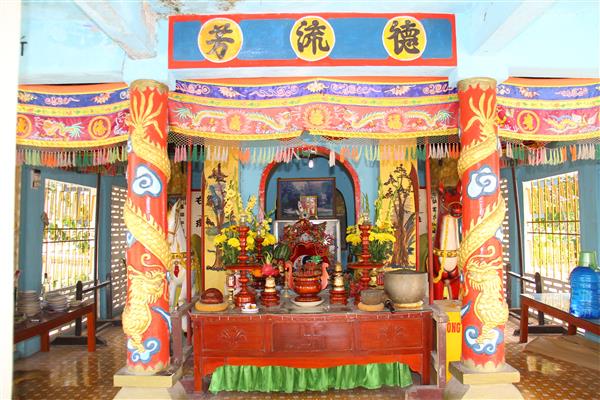
The main temple of the Crown Prince
The temple of the Crown Prince still preserves 02 ordinations, conferred by King Khai Dinh, ordering the worship of Tan Vuong Dai Can Crown Prince. The worship of Tan Vuong Dai Can Thai Tu is also worshiped at An Dinh Dinh (Dien Phuoc commune, Dien Khanh district) and the villagers here consider Tan Vuong Dai Can Thai Tu as the village Thanh Hoang. Thus, the worship of Tan Vuong Dai Can Thai Tu is not only in the temple but also in the communal house of An Dinh village.
The temple is located on a low, gentle hill with a large space. When it was first built, the temple of Thai Tu was a small communal house, with tile roof, tetrahedral columns, standing on a pile of natural stones, covering a rock. Surrounded by magnetism, the word object is a stone chessboard with all sets, a stone chess piece, a pair of stone shoes and a set of stone mortars and pestles and this place is said to be very sacred.
Experiencing the same historical ups and downs, in 1945, the temple of the Crown Prince was burned by the French invaders. But then people in the village and visitors from all over the world contributed to rebuilding. In 1994, the villagers overhauled.
The temple of the Crown Prince is located at the foot of Hon Ngang hill at the end of Dong Lon, the temple faces southwest. The relic includes the ritual gate, the sacrifice, the main hall, the Tien Hien temple, the Son Lam temple, and the marriage house.
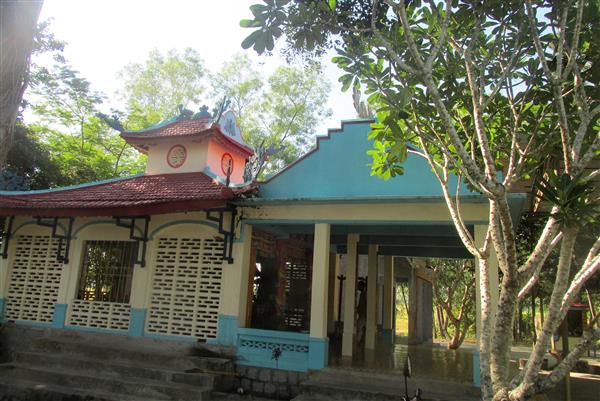
 The right side of the temple is to worship the Crown Prince
The "open-walled" architecture is relatively special compared to the architectural system of relics on Khanh Hoa land, which is often closed and shows depth. The worshiping statue is primitive in nature (natural rock).
Decorative patterns at the roof, strip and mascot systems of the relic are in the style of Vietnamese folk beliefs such as: two dragons adoring the moon, dragons, unicorns, turtles, phoenixes, daisies, chrysanthemums, bamboo, etc. apricot, horse…
During the resistance war against the French (1945 - 1954), this place was the mobile headquarters of the Resistance Committee of Khanh Hung commune (including communes: Dien Lac, Dien Loc, Dien Tho, Dien Phuoc, Dien Lam, Dien, Dien Lam and Dien). Binh, Dien Hoa today).
During the resistance war against the US, this was the place to transit food for the revolution.
The festival at the relic takes place officially on the 23rd and 24th of the second lunar month. The traditional festival is held annually, the cultural activities in the festival are very rich and diverse, including the ceremony and the festival, in which both Cham and Vietnamese people participate.
Legend of the character worshiped in the temple:
- The first legend (according to the content of the stele of Phan Thanh Gian erected in 1856 at the monument of Ponagar Ponagar in Nha Trang).
- The second legend according to the village's elders: Crown Prince is the son of King Ba Tranh (old Champa), the villagers can't remember the name clearly. In 1692, Ms. Tranh sent the Crown Prince from Phan Rang to establish his capital at Dong Say (Dien Tan commune area), when the Prince led his army to resist the army of Lord Nguyen led by General Nguyen Huu Canh to occupy Dien Ninh. When the crown prince lost the battle, he tried to run back and entrench at the capital of Dong Say, when he ran through Am Phu mound, he was martyred at the gate of Truong Xuan Dai. Legend has it that when the Prince died, a drop of blood splashed on the stone where the temple was built at that time. Since then, a very sacred headless stone statue has sprouted. The villagers here saw this and worshiped the stone statue.
With the above typical values, on December 30, 2010 Khanh Hoa Provincial People's Committee issued Decision No. 3425/QD-UBND ranking Thai Tu Temple as a provincial historical - cultural relic.