Thông tin chi tiết
The relic is located in Phu Hoi village, Van Thang commune, Van Ninh district, Khanh Hoa province. (formerly Phu Hoi Tay village, belonging to Ha canton, Quang Phuoc district, Binh Hoa government). The relic is located 63 km north of Nha Trang city.
Through studying the history of Phu Hoi communal house, there is not a single document that mentions the time of construction of the communal house, so it is only possible to rely on the ordination documents of the communal house to determine the relative date. The earliest ordination date is Tu year 5 (1852) conferred on Ban Canh Thanh Hoang, so it can be determined that Phu Hoi communal house was built before 1852. The monument was originally built simply of bamboo. , roof leaves. Over time, the community has become more and more crowded with spiritual and religious needs, and villagers want a more spacious communal house. In 1928, the communal house was restored for the first time with the contribution of the people (the communal house was built of limestone, roofed with yin and yang tiles). In 1967, the communal house was renovated for the second time with the contribution of the people (mainly materials are bricks, cement, wooden frames were kept, replaced yin and yang tiles with western tiles).
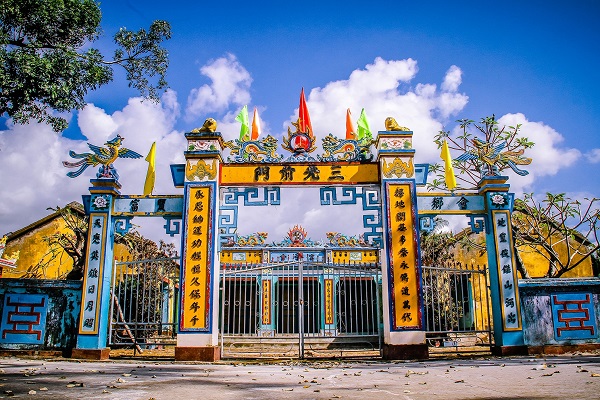

Phu Hoi Communal House today
Phu Hoi communal house is located on a flat land with beautiful terrain, large and airy space in the middle of the village under the canopy of ancient trees (banana, tamarind, water lily, rice, mango), with an area of 5,312.6m2, facing south.
The relic has an overall layout including: foreign rituals, internal rituals, feng shui projects, courtyards, front halls, main halls, east and west houses.
In addition to the unique beauty of architectural art, Phu Hoi communal house also preserves many relics and antiques of great historical and cultural value: Han Nom documents, long communal houses, parasols, gongs, drums, etc. rites, rituals, worshiping rituals, literature, ritual music, costumes and especially 05 ordinations conferred by the kings of the Nguyen Dynasty, including:
- Sac Tu Duc in the 5th year (1852) conferred on Ban Canh Thanh Hoang;
- Sac Tu Duc year 33 (1880) conferred on Ban Canh Thanh Hoang;
- Sac Dong Khanh in the second year (1887) conferred the title of Thanh Hoang Ban Canh;
- Sac Duy Tan in the 3rd year (1909) conferred the title of Thanh Hoang Ban Canh;
- Sac Khai Dinh in the 9th year (1924) conferred the title of Thanh Hoang Ban Canh.
Every year, the traditional festival is held on the auspicious day of March and August of the lunar calendar.
Phu Hoi communal house was built around the beginning of the nineteenth century, due to the needs of the community when they came to the newly reclaimed land and established a hamlet. This is a traditional feature of religious rituals in the spiritual life of Khanh Hoa people in general and Van Ninh people in particular. Since its construction, Phu Hoi communal house has become the center of cultural and religious activities of the people. The relic contains many historical, cultural and especially architectural values of the Nguyen Dynasty in the land of Khanh Hoa. The most prominent feature of the communal house is the wooden frame bearing structure system with sophisticated decorative patterns, bearing the local traditional style that is still preserved here. Because of the above typical values, Phu Hoi communal house has been classified as a provincial relic by the People's Committee of Khanh Hoa province, issued Decision No. 1111/QD-UBND, dated April 22, 2010.