Description
Phu An Nam communal house (also known as Phu An communal house), now belongs to Phu An Nam village, Dien An commune, Dien Khanh district, Khanh Hoa province. When it was first established, Phu An village consisted of 4 villages: Mien Hoa, Bach Qua, Phat Tinh and Thanh Tu. Initially, Phu An communal house was built on the left bank of Cai river in two villages: Mien Hoa and Bach Qua. Later, because the two villages on the right bank of the Cai River (Thanh Tu and Phat Tinh) prospered, the economy was stronger, the roads were convenient, and there was Dien Khanh Palace, so the local government and people in the area. The village decided to move the communal house to build in the South with the current position. Based on the current documents at the communal house, the year the communal house was moved to its present location was 1885.
The communal house has undergone many restorations, but the most recent major restorations are in the following years: 1956; 1996; 2007.
Based on the divine ordinations that the Nguyen court had bestowed on Phu An village, the communal house of Phu An village was allowed by the Nguyen king to worship the gods: Dai Can Quoc Quoc Nam Hai, the four holy women of Thuong rank, Cao Cao worships gods, in addition, the communal house also worships Tho Cong, Soldier, Am Co, Tien Hien, Hau Hien:
- The first ordination: Five-year-old Tu Duc (1852) conferred on Dai Can nation Nam Hai four deities;
- Second ordination: Tu Duc five years (1852) conferred on Cao Cac deities;
- The third ordination: Tu Duc in the three decades (1880) conferred on Dai Can the Nam Hai nation the four highest gods;
- The fourth ordination: Dong Khanh Nhien (1887) conferred on Cao Cac superior deity;
- The fifth ordination: Dong Khanh in the second year (1887) conferred the title of Dai Can on the Nam Hai nation with four superior gods;
- The sixth ordination: Duy Tan for three years (1909) conferred the title of Dai Can on the Nam Hai nation with four superior gods;
- The seventh ordination: Khai Dinh 9 (1924) conferred on Dai Can the Nam Hai nation the four superior gods;
- The eighth ordination: Khai Dinh 9 (1924) Cao Cac superior god;
The communal house is located on a relatively flat land, facing the East, the overall communal house has the following works: Nghi Mon, Great Communal House, Tien Hien Temple, Tho Cong Temple, East House.
Phu An communal house is a communal house that still preserves the original architectural structures of the ancient communal house on Khanh Hoa land. The money and the main hall are linked together, the main hall keeps many horizontal concubines, couplets, set plates, and ordinations. In the middle, there is an altar to worship the Council, after that there is a altar to worship God, the altar is painted with gold paint, the roof is carved with a picture of two dragons, and the two sides worship Ta ban and Huu ban.
To the east of the main hall is the east house, designed with 3 compartments and 2 wings, the architectural structure includes 4 rows of columns, 2 rows of female columns and 2 rows of military columns.

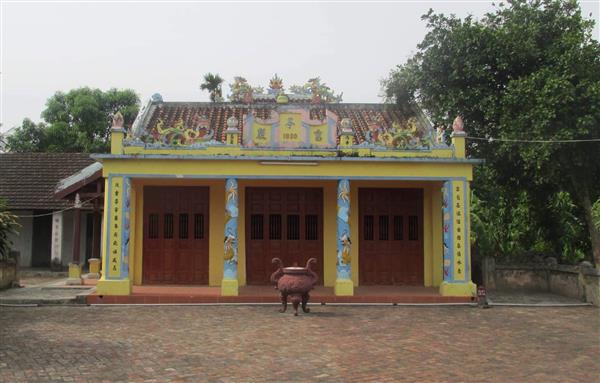
(Phu An Nam's main palace)
During the resistance war against the French invasion, Phu An communal house was a major revolutionary base of Dien Khanh district. After the successful August Revolution, the revolutionary government apparatus was established, the prestige of the Viet Minh Front was great. To strengthen the fledgling revolutionary government, the Viet Minh gathered a large number of people from all walks of life to Phu An communal house to study the Viet Minh charter program. In order to equip the militia and self-defense forces in the village, the Viet Minh Front also gathered a number of local blacksmiths in Phu An communal house to forge spears and swords. Phu An communal house is also the venue for a popular class on literacy eradication, many people know how to read Quoc Ngu after taking this class; In addition, Phu An communal house became an important place for revolutionary soldiers to take shelter because the terrain bordered the Cai River, which was convenient for escape.
During the period of resistance against the American invasion, continuing the indomitable struggle tradition of his father's generation, brothers such as Nguyen Tong, Nguyen Huu Bich, Pham Thi Chuong ... still continued their revolutionary activities, day in the war. At night, the village took shelter in the communal house to mobilize people to fight and protest against the oppression of the US imperialists.
The village communal house celebrates in spring and autumn, offering annual rituals on auspicious days in the third lunar month. From 3 years or more due to the response of the people's contributions to organize the choir.
With typical historical - cultural values, in 2008 Phu An communal house was issued by Khanh Hoa Provincial People's Committee Decision No. 708/QD- People's Committee ranked as a provincial historical - cultural relic.